

From the Founder
What is the 9x12 method? How the 9x12 postcard method works
The 9x12 method is a shared direct mail model where operators sell ad spots on oversized postcards mailed to local neighborhoods. Here's exactly how it works, what it costs, and what you need to get started.
Dustin Myers · April 12, 2026 · 12 min read
What is the 9x12 method?
The 9x12 method — sometimes called the 9x12 postcard method, the 9 by 12 method, or the shared mailer method — is a direct mail business model built around one simple idea: multiple local businesses share the cost of a single oversized postcard that gets mailed to every home in a neighborhood.
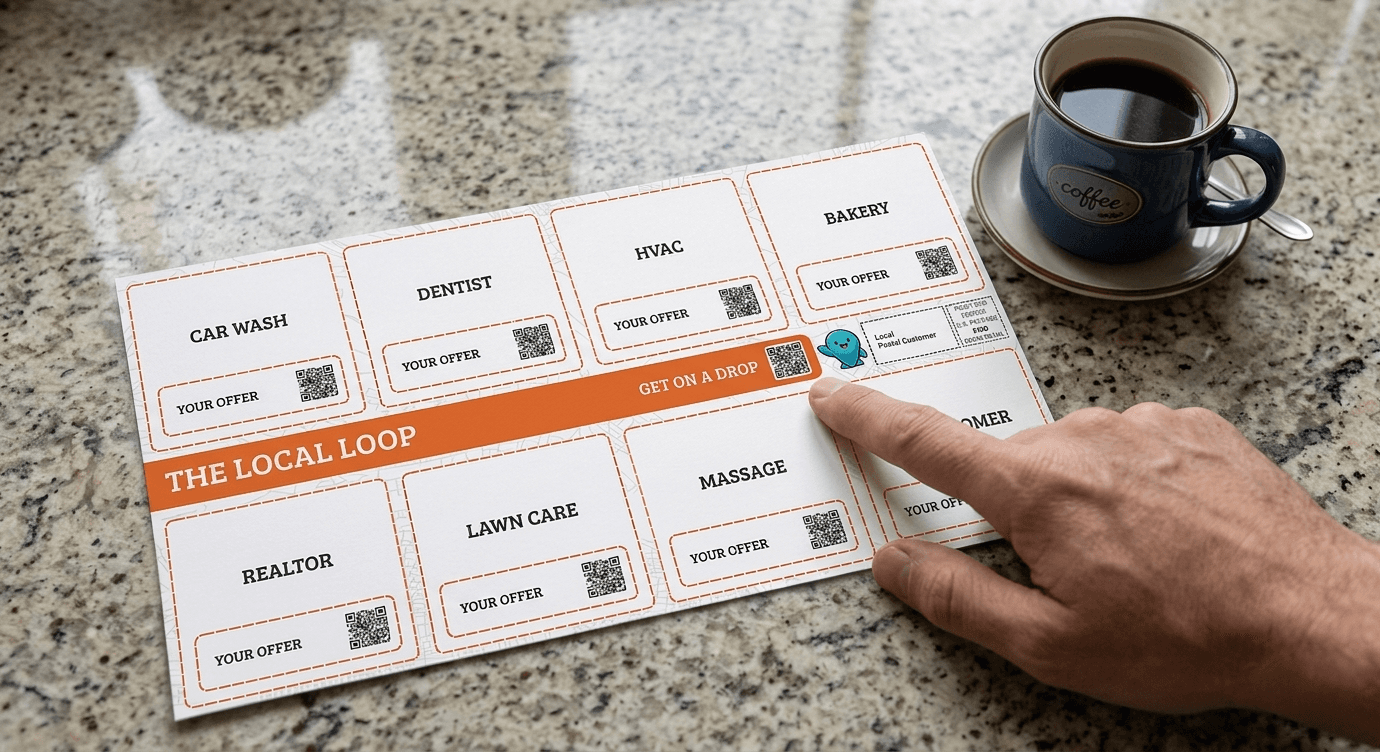
A shared mailer card with ad spots for local businesses, each with a scannable QR code.
The name comes from the card size: 9 inches by 12 inches. It's an oversized postcard — large enough to feature 14 to 16 individual ad spots, each one belonging to a different local business. A restaurant, a dentist, a landscaper, a chiropractor — all on the same card, all sharing the cost of printing and postage.
There are two roles in this model. The operator is the person who creates the card, sells the spots, manages the design, and handles the mailing. The advertiser is the local business that buys a spot on the card. The operator profits from the difference between what they collect from advertisers and what it costs to print and mail the cards.
Delivery happens through USPS Every Door Direct Mail (EDDM), a program that lets you mail to every residential address on a postal carrier route without needing a mailing list. The concept was pioneered by High Response Marketing and has grown into an entire industry of independent operators running shared mailer businesses in communities across the country.
How the 9x12 postcard method works
A single mailing cycle is called a “drop.” Each drop targets a specific geographic area, features a set of advertisers, and gets printed and mailed as one batch. Here's how a typical drop works from start to finish.
Step 1: Choose your mailing area
The operator picks a ZIP code and selects specific USPS carrier routes within that ZIP. Each route covers 400 to 800 residential addresses. Most operators target 5,000 homes per drop, which means selecting 7 to 12 routes. Tools like the SpotDrops route planner show demographics for each route — household income, household size, age distribution — so you can pick routes that match your advertisers' target customers.
Step 2: Design the card
The operator creates the postcard layout, allocating space for each ad spot. Most 9x12 cards feature 14 to 16 spots arranged in a grid. Each spot typically includes the business name, logo, a short offer or tagline, contact information, and a QR code. Many operators use Canva or professional design tools for layout.
Step 3: Sell the spots
This is where the revenue comes from. Each spot sells for $200 to $500 depending on the market, the mailing volume, and the card format. The operator reaches out to local businesses — in person, by phone, by email, or through an online checkout link — and sells them on the value of reaching every home in the neighborhood for a fraction of what solo direct mail would cost.
Step 4: Collect business assets
Once a spot is sold, the operator collects the business logo, ad copy, offer details, and contact information. SpotDrops handles this automatically through its advertiser intake form — advertisers fill in their details online, upload their logo, and everything lands in the operator's dashboard ready for design.
Step 5: Print and mail via EDDM
Once the card is designed and spots are filled, the operator sends the artwork to a printer. The printed cards are bundled by carrier route and dropped at the post office for EDDM delivery. Delivery to mailboxes typically takes 3 to 14 business days depending on the local post office.
Step 6: Track results and repeat
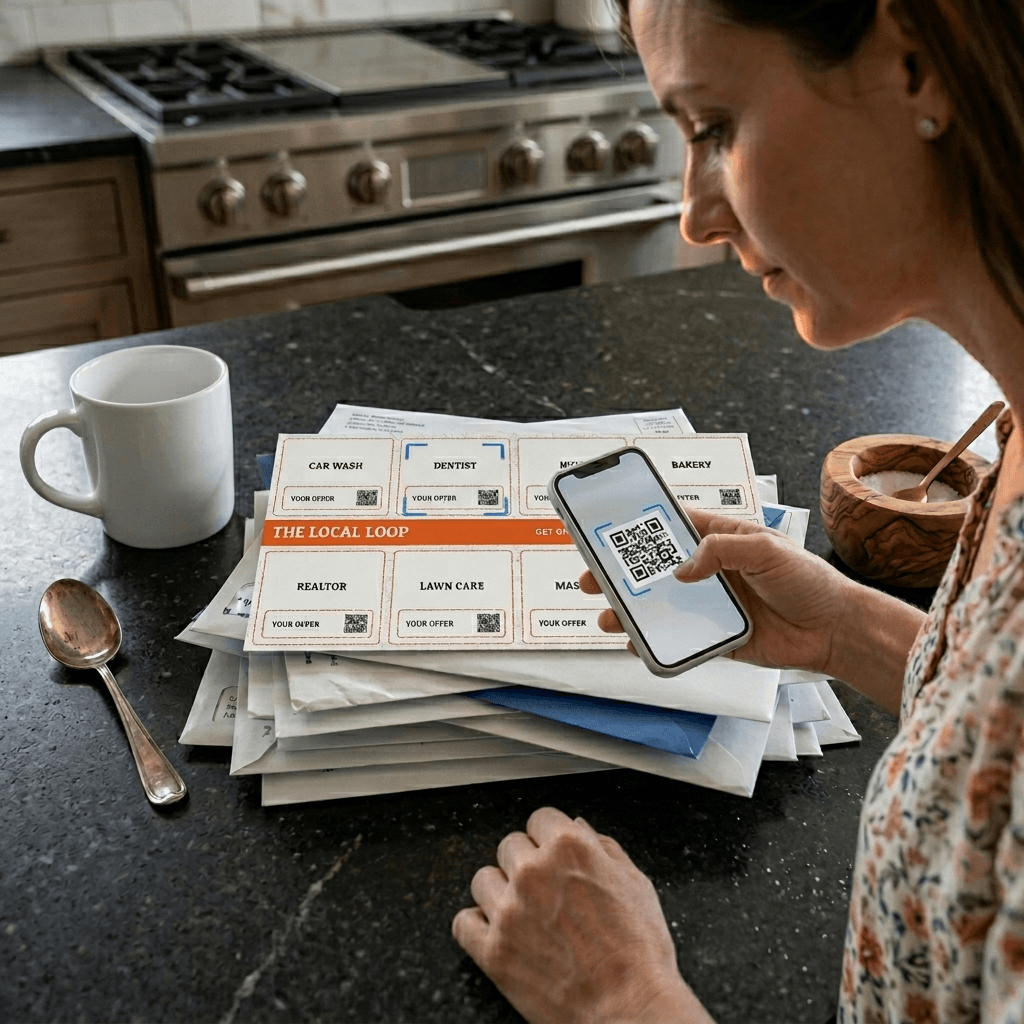
Homeowners scan QR codes on the card to access offers from local businesses.
Each spot includes a QR code that links to a branded landing page for the business. When a homeowner scans the QR code, SpotDrops tracks the scan — giving both the operator and the advertiser real data on engagement. This data makes renewal conversations easy: you can show advertisers exactly how many people scanned their code, visited their page, and clicked through to their website or phone number.
The economics
Revenue
A typical 9x12 postcard features 16 ad spots. At $400 per spot, that's $6,400 in gross revenue per drop. Some operators charge $300 in smaller markets or $500 in premium areas. The math scales linearly — more spots sold at higher prices means more revenue.
Costs
Printing 5,000 oversized 9x12 postcards on 14pt cardstock typically costs around $970. EDDM postage runs $0.247 per piece at the retail rate ($1,235 for 5,000 pieces). Total print and mail cost for a 5,000-piece drop comes to roughly $2,200. Some operators use turnkey printing services that handle everything at around $0.32 per piece all-in.
Software is the other variable cost. Some platforms charge $100–200/month in subscriptions regardless of whether you sell anything. SpotDrops charges $0/month and takes 7% only when spots sell — so your software cost scales with your revenue, not ahead of it. See the full breakdown on the pricing page.
Profit
At $6,400 in revenue and $2,200 in costs, the operator nets around $4,200 per drop. Operators running two drops per month across two different ZIP codes can earn $8,000+ monthly. Scaling to 4 to 8 drops per month across multiple markets can reach six figures annually.
9x12 vs 6x11
The 9x12 postcard isn't the only shared mailer format. The 6x11 community card is a smaller alternative that uses the same business model. Here's how they compare.
| 9x12 | 6x11 | |
|---|---|---|
| Card size | 9" x 12" | 6" x 11" |
| Typical spots | 14-16 | 14-16 |
| Spot price range | $300-$500 | $150-$250 |
| Typical mailing volume | 5,000+ homes | 2,500 homes |
| Print + mail cost | $2,200-$2,800 | $1,000-$1,500 |
| Gross revenue | $5,600-$8,000 | $2,100-$4,000 |
| Best for | Experienced operators, higher margins | New operators, lower barrier to entry |
SpotDrops supports both formats. The 6x11 community card is popular with new operators because it has a lower barrier to entry — fewer homes, lower costs, and more spots to sell at lower price points. Many operators start with 6x11 and graduate to 9x12 as they build confidence and territory.
What EDDM is
EDDM stands for Every Door Direct Mail. It's a USPS program that lets you mail to every residential address on a postal carrier route without needing a mailing list. You don't need names, addresses, or any customer data — USPS delivers to every door on the routes you select.
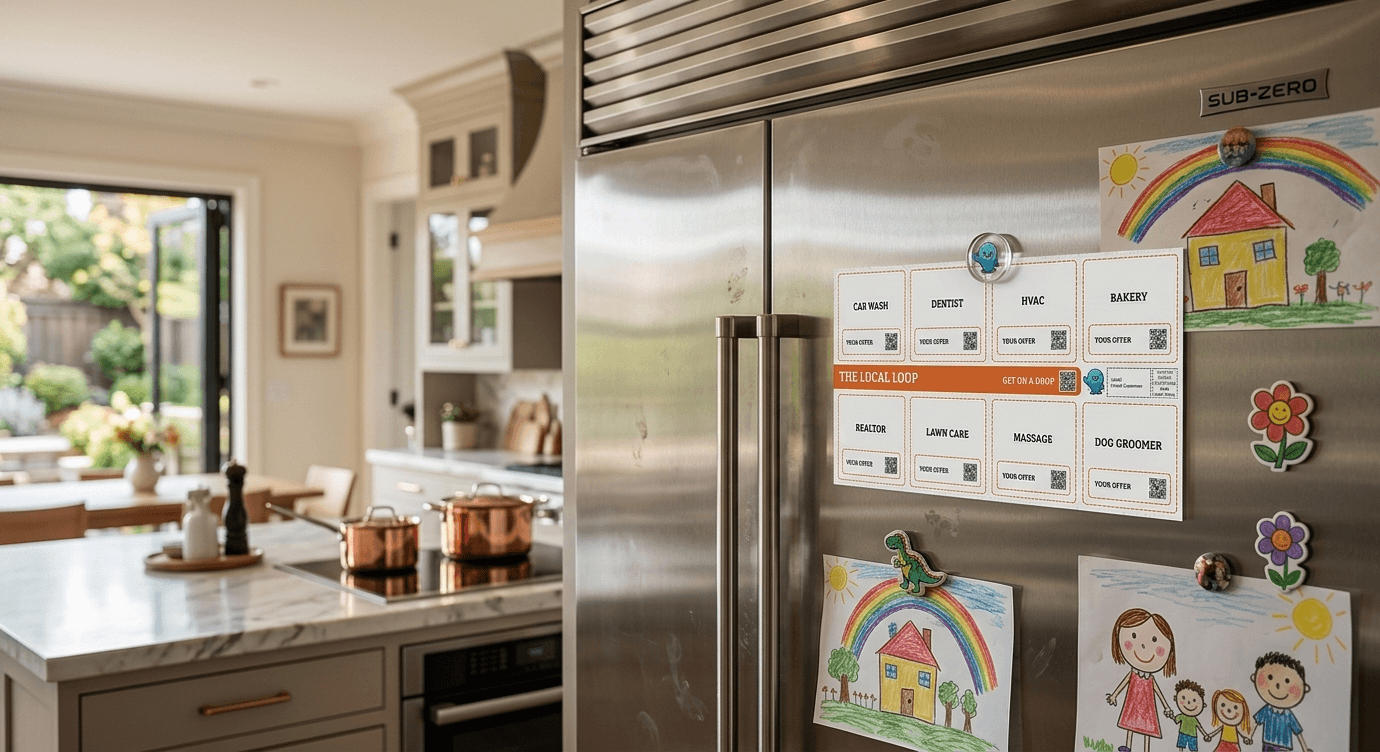
Community cards often end up on the fridge — keeping local businesses visible for weeks.
Current EDDM postage rates are $0.247 per piece at the retail rate and $0.242 per piece at the BMEU (Business Mail Entry Unit) rate. Each carrier route covers 400 to 800 households. You select routes by ZIP code, and USPS provides demographic data for each route — household income, age, household size — so you can target neighborhoods that match your advertisers' ideal customers.
The SpotDrops route planner visualizes routes on a map, shows demographics in a side panel, and lets you auto-select routes based on household count targets. It takes what used to be a manual process of cross-referencing USPS data and turns it into a few clicks.
How to sell spots
Selling spots is the core skill of this business. There are three main approaches, and most successful operators use all three.
In-person prospecting
Walking into local businesses with a sample card has the highest close rate. Business owners can see the product, feel the card stock, and picture their ad alongside other local brands. This is how most operators fill their first few cards.
Cold email and cold calling
Once you've got a track record, outbound prospecting scales faster. Tools like SpotLeads automate the prospecting step by scraping Google Maps for businesses near your mailing area, giving you contact info, categories, and ratings to work from.
Online self-service checkout
The most scalable approach is letting businesses buy spots online. SpotDrops provides a public drop page for each card where businesses can browse available spots, see pricing, and check out with a credit card. The operator shares the link via email, text, or social media, and spots sell without any back-and-forth.
The pitch to advertisers is straightforward: a solo EDDM mailing costs $2,200+ for 5,000 homes. A shared spot on a community card costs $200–$500 and reaches the same mailboxes. It's a fraction of the cost for the same reach.
Software and tools
You can start a 9x12 postcard business with spreadsheets, Canva, and the USPS EDDM tool. Many operators do. But as you scale past one or two drops, the manual processes break down fast — tracking who paid, chasing down logos, planning routes, following up on renewals.
Here's what you need as you grow:
- Drop management — create, organize, and track drops across markets
- Online checkout — let advertisers purchase spots with a credit card
- Payment processing — collect payments and track who's paid
- EDDM route planning — select carrier routes with demographic data
- QR code tracking — prove engagement to advertisers with scan data
- Renewal automation — prompt previous advertisers when new drops launch
- CRM — manage prospects, track outreach, and close deals
SpotDrops covers all of these in one platform for $0/month with a 7% fee when spots sell. See how it works or read the SpotDrops vs the 9x12 Method comparison.
Common mistakes
Underpricing spots
New operators sometimes price spots too low to “make it easy.” But even at $400, a spot reaching 5,000 homes costs the advertiser just $0.08 per household — dramatically cheaper than a solo EDDM mailing at $0.50+ per piece. Low prices don't just cut your margin, they signal low value. Price for what the exposure is worth.
Waiting for 100% fill rate
Some operators hold off on printing until every spot is sold. This delays the entire drop and can cost you momentum. Most experienced operators lock the card and go to print at 70–80% fill. The remaining spots can be sold to businesses who want in at the last minute, or the operator absorbs the cost of a few empty spots — still profitable overall.
No tracking
If you don't track engagement, you can't prove value to advertisers. QR codes with scan tracking turn “I think it's working” into “your ad was scanned 47 times last month.” That data is what drives renewals and lets you raise prices over time.
Staying in one ZIP code
The 9x12 method scales horizontally. Once you've figured out the process in one ZIP code, replicating it in the next one is straightforward. Your printing costs don't change, your process is dialed in, and you can prospect in the new area while the current drop is in the mail. Operators who stay in one ZIP cap their income at $2,000–$3,000/month. Those who expand to 3–5 ZIPs break into five figures. But scaling across multiple areas requires systems — tracking spots, managing payments, coordinating timelines, and keeping advertisers organized across every drop. That's exactly what SpotDrops is built for.
Getting started
Here's a straightforward action plan to launch your first 9x12 drop.
- Pick your ZIP code. Choose a residential area with 5,000+ households, ideally one you know well or live in.
- Select your routes. Use the USPS EDDM tool or the SpotDrops route planner to pick 7–12 carrier routes that hit your household target.
- Set your pricing. Start at $300–$400 per spot. You can always adjust on your next drop based on demand.
- Sell 4–5 spots before you design. Pre-selling covers your costs and validates demand before you invest in printing.
- Design, print, and mail. Once you're at 70–80% fill, lock the card, finalize the design, send it to the printer, and drop it at the post office.
- Track, follow up, and repeat. After the cards hit mailboxes, share scan data with your advertisers. Start selling spots for the next drop while the current one is still delivering.
Ready to run the 9x12 method?
SpotDrops gives you everything you need to manage drops, sell spots online, plan EDDM routes, and track engagement — for $0/month.
Start Your First CardWatch the walkthrough
— Dustin Myers, creator of 9x12tools.com and SpotDrops